


Share This Article:
Fall Into Safety
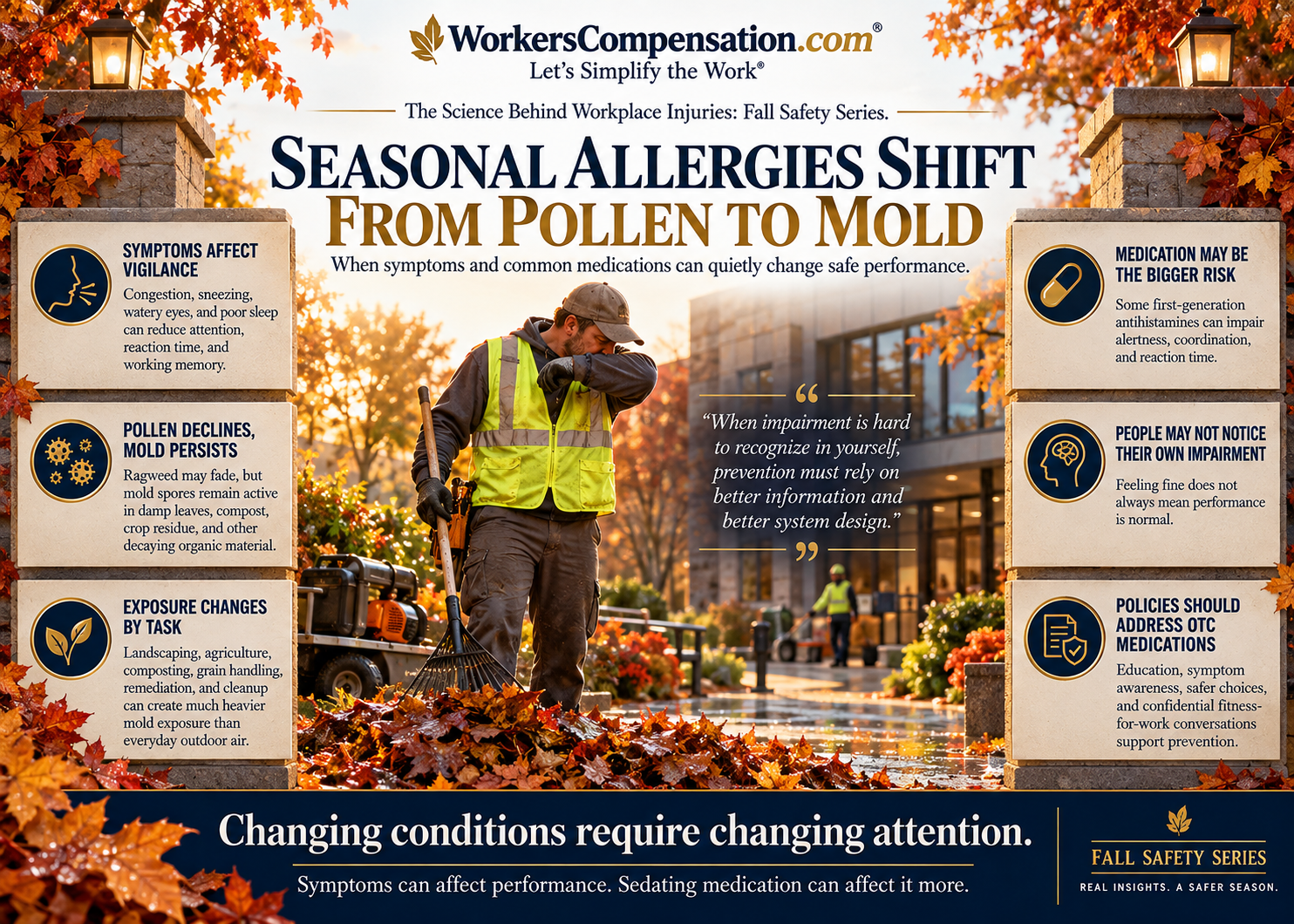
Welcome to The Science Behind Workplace Injuries: Fall Safety Series, where we explore how seasonal conditions interact with human physiology, behavior, and workplace systems. Yesterday, we examined how workplaces can become transmission systems for respiratory viruses. Autumn brings another respiratory shift as ragweed begins to decline and outdoor mold spores remain active in decaying leaves, crop residue, compost, and other organic material.
The transition is gradual and regional. Ragweed and mold overlap during early fall, while outdoor mold can remain present after the first frost and decline substantially once snow covers vegetation. For workers with allergic rhinitis, the changing allergen matters. For workplace safety, however, the more consequential question may be what happens after symptoms begin—and what workers take to control them. The research does not establish that autumn mold exposure causes workplace injuries. The evidence points instead toward impaired vigilance from allergy symptoms and, more significantly, impairment associated with some common allergy medications.
Allergy Symptoms Affect More than the Nose
Allergic rhinitis produces inflammation, congestion, sneezing, watery eyes, and other familiar symptoms. Cognitive effects are less visible. Jeffrey Wilken, Robert Berkowitz, and Robert Kane exposed adults with seasonal allergic rhinitis to ragweed under controlled conditions and compared their performance with asymptomatic participants. Symptomatic participants showed reduced vigilance, longer response times, and decreased efficiency in working memory, psychomotor speed, reasoning, and divided attention. The allergen in the experiment was ragweed, so the findings should not be presented as mold-specific, but the study demonstrates that untreated allergic rhinitis can affect cognitive performance.
Sleep adds another pathway. Nasal congestion increases airway resistance and can fragment sleep even when total sleep time remains relatively normal. A 2020 systematic review and meta-analysis found allergic rhinitis associated with poorer sleep quality and greater daytime sleepiness, although the authors rated the underlying evidence as low to very low quality. A worker may therefore begin the day carrying both active symptoms and the effects of disrupted sleep.
The Medication May Create the Greater Safety Problem
First-generation antihistamines such as diphenhydramine cross the blood-brain barrier and interfere with histamine's role in wakefulness. The resulting impairment can affect reaction time, divided attention, coordination, and alertness. The distinction matters because many workers encounter diphenhydramine in familiar over-the-counter allergy, cold, sleep, and “PM” products.
John Weiler and colleagues demonstrated the magnitude of the effect in a randomized crossover trial conducted in the University of Iowa Driving Simulator. Forty licensed drivers received fexofenadine, diphenhydramine, alcohol producing approximately a 0.1% blood alcohol concentration, or placebo before driving for an hour. Driving performance was poorest after diphenhydramine. Participants performed similarly after fexofenadine and placebo.
The behavioral finding may be even more useful for safety professionals: participants could not reliably recognize their own impairment. Self-reported drowsiness did not predict poor driving coherence and was only weakly associated with several other performance measures. Feeling alert therefore did not mean the driver was performing normally. A safety-sensitive worker using a sedating antihistamine may sincerely report feeling fine while experiencing measurable impairment.
Real-world occupational data point in the same direction. Timothy Gilmore and colleagues examined pharmacy records for 3,394 workers diagnosed with occupational injuries and matched controls. Antihistamine users had approximately 1.5 times the odds of occupational injury, although the observational design cannot establish whether medication itself caused the injuries. A later Wisconsin study by Lawrence Hanrahan and L. Clark Paramore examined workers' compensation applicants and found sedating-antihistamine exposure associated with higher odds of acute traumatic injury. The study evaluated pollen exposure rather than mold, another reason to keep the autumn-mold connection appropriately narrow.
Mold Becomes a Different Hazard at Occupational Doses
Seasonal allergy is only one piece of autumn mold exposure. Agriculture, grain handling, landscaping, composting, mold remediation, demolition, and disaster cleanup can generate concentrations far beyond ordinary environmental exposure. Moldy hay, grain, silage, compost, and other organic material can release enormous quantities of spores and organic dust when disturbed.
Heavy exposure can produce organic dust toxic syndrome (ODTS), an inflammatory illness that can cause fever, cough, chills, muscle aches, and shortness of breath several hours after exposure. Repeated occupational exposure can also contribute to hypersensitivity pneumonitis, including farmer's lung, an immune-mediated disease capable of causing chronic lung damage. Neither condition requires the worker to have a conventional mold allergy. OSHA estimates approximately one in ten agricultural workers will experience an episode of ODTS.
The distinction changes prevention. Outdoor seasonal allergies may call for symptom management and careful medication selection. Task-generated mold and organic dust require exposure controls: keeping stored crops and building materials dry, controlling dust at the source, using ventilation or filtered equipment cabs, minimizing unnecessary disturbance of contaminated material, and providing appropriate respiratory protection when exposure requires it. Moisture control remains one of the most effective ways to prevent occupational mold problems before spores become airborne.
Safety Policies Should Account for What Workers Take
Many organizations have detailed policies addressing alcohol, illicit drugs, fatigue, and prescription medications while saying little about over-the-counter products. The label “over the counter” describes availability, not the absence of performance effects. Safety-sensitive jobs deserve specific attention because driving, operating machinery, working at height, and responding to rapidly changing hazards depend heavily on vigilance and reaction time.
The evidence also argues against telling workers simply to endure allergy symptoms. Untreated allergic rhinitis can impair vigilance, while second-generation antihistamines such as fexofenadine have demonstrated substantially less cognitive and psychomotor impairment than first-generation medications. Medication decisions belong between workers and appropriate health professionals, but employers can educate employees about sedation warnings, encourage workers to review active ingredients, and create a confidential process for discussing fitness for safety-sensitive work.
Workers' compensation data will rarely reveal the medication connection. A fall, collision, or machine injury is coded according to the event and resulting injury. The antihistamine taken the previous evening may never appear in the claim record. Occupational respiratory disease can be similarly underrepresented: Michigan surveillance spanning 31 years found that 51% of confirmed work-related asthma cases never applied for workers' compensation benefits.
Autumn changes the allergen environment, but exposure alone tells only part of the safety story. Symptoms can affect vigilance. Treatment can introduce additional impairment. High occupational doses can produce respiratory disease far beyond ordinary seasonal allergies. When impairment is difficult for people to perceive in themselves, prevention has to rely on better information and better system design.
Tomorrow in The Science Behind Workplace Injuries: Fall Safety Series — Indoor Air Quality as Buildings Close Up. As windows close and heating systems return to service, ventilation, moisture, filtration, carbon dioxide, and indoor contaminants begin shaping another part of the fall workplace environment.
Research Referenced
Gilmore, T. M., Alexander, B. H., Mueller, B. A., & Rivara, F. P. (1996). Occupational injuries and medication use. American Journal of Industrial Medicine, 30(2), 234–239. doi:10.1002/(SICI)1097-0274(199608)30:2<234::AID-AJIM16>3.0.CO;2-Y
Hanrahan, L. P., & Paramore, L. C. (2003). Aeroallergens, allergic rhinitis, and sedating antihistamines: Risk factors for traumatic occupational injury and economic impact. American Journal of Industrial Medicine, 44(4), 438–446. doi:10.1002/ajim.10285
Weiler, J. M., Bloomfield, J. R., Woodworth, G. G., Grant, A. R., Layton, T. A., Brown, T. L., McKenzie, D. R., Baker, T. W., & Watson, G. S. (2000). Effects of fexofenadine, diphenhydramine, and alcohol on driving performance: A randomized, placebo-controlled trial in the Iowa Driving Simulator. Annals of Internal Medicine, 132(5), 354–363. doi:10.7326/0003-4819-132-5-200003070-00004
Wilken, J. A., Berkowitz, R., & Kane, R. (2002). Decrements in vigilance and cognitive functioning associated with ragweed-induced allergic rhinitis. Annals of Allergy, Asthma & Immunology, 89(4), 372–380. doi:10.1016/S1081-1206(10)62038-8


AI best practices california case file caselaw case management case management focus claims compensability compliance compliance corner courts do you know the rule employers exclusive remedy florida fraud glossary check Healthcare hr homeroom insurance insurers iowa kentucky leadership NCCI new jersey new york ohio pennsylvania Safety safety at work state info tech technology the case manager violence WDYT what do you think women's history women's history month workers' comp 101 workers' recovery Workplace Safety Workplace Violence
Read Also
About The Author
About The Author
-
Claire Muselman
Meet Dr. Claire C. Muselman, the Chief Operating Officer at WorkersCompensation.com, where she blends her vast academic insight and professional innovation with a uniquely positive energy. As the President of DCM, Dr. Muselman is renowned for her dynamic approach that reshapes and energizes the workers' compensation industry. Dr. Muselman's academic credentials are as remarkable as her professional achievements. Holding a Doctor of Education in Organizational Leadership from Grand Canyon University, she specializes in employee engagement, human behavior, and the science of leadership. Her diverse background in educational leadership, public policy, political science, and dance epitomizes a multifaceted approach to leadership and learning. At Drake University, Dr. Muselman excels as an Assistant Professor of Practice and Co-Director of the Master of Science in Leadership Program. Her passion for teaching and commitment to innovative pedagogy demonstrate her dedication to cultivating future leaders in management, leadership, and business strategy. In the industry, Dr. Muselman actively contributes as an Ambassador for the Alliance of Women in Workers’ Compensation and plays key roles in organizations such as Kids Chance of Iowa, WorkCompBlitz, and the Claims and Litigation Management Alliance, underscoring her leadership and advocacy in workers’ compensation. A highly sought-after speaker, Dr. Muselman inspires professionals with her engaging talks on leadership, self-development, and risk management. Her philosophy of empathetic and emotionally intelligent leadership is at the heart of her message, encouraging innovation and progressive change in the industry. "Empowerment is key to progress. By nurturing today's professionals with empathy and intelligence, we're crafting tomorrow's leaders." - Dr. Claire C. Muselman
More by This Author
Read More
- Oct 03, 2026
- Frank Ferreri
- Oct 01, 2026
- Chris Parker
- Oct 01, 2026
- Claire Muselman
- Oct 01, 2026
- Claire Muselman
- Oct 01, 2026
- Claire Muselman
- Sep 28, 2026
- Frank Ferreri